Every serious industry has a way to test what it can't see.
AI finally has one.
We measure how often the language model you run makes things up, using your own questions, and hand you a signed report your governance file can use.
No customer data touched · Nothing installed · Fixed fee · Five business days
Someone is going to ask for your AI testing evidence.
We read the model's internal signals as it writes.
When a language model knows something, its token probabilities concentrate, and when it makes something up they scatter across several guesses. That difference is measurable at every token, without ground truth and without your data. The method grew out of ultrasonic non-destructive testing, which is how you inspect a weld without cutting it open.
In testing so far it catches fabricated answers at 0.852 AUC on models it has never seen before: fabricated-entity discrimination, length-controlled, leave-one-model-out. Published in the lab's method paper (DOI: 10.5281/zenodo.21365654).
"Celtrazine" does not exist. Watch the model invent an approval year, a dosage, and a loading dose, and watch the signal catch each one. Simulated for the web; the real instrument runs against your model, on your questions.
Five business days, and no meetings.
Send your question types
The kinds of questions your model faces in production. No customer records, no member data, no PHI.
COVERED BY WRITTEN CONFIDENTIALITY AGREEMENTDesignate an endpoint
We measure against a deployment you control, inside systems you govern.
NO-PHI VENDOR BY DESIGNReceive the signed report
Signed and dated, with the complete findings file, so your team can check every flagged answer.
DELIVERED ≤5 BUSINESS DAYS FROM MATERIALS-COMPLETESee the work before you decide.
 SIGNED & DATED
VERIFIABLE FINDINGS
SIGNED & DATED
VERIFIABLE FINDINGS
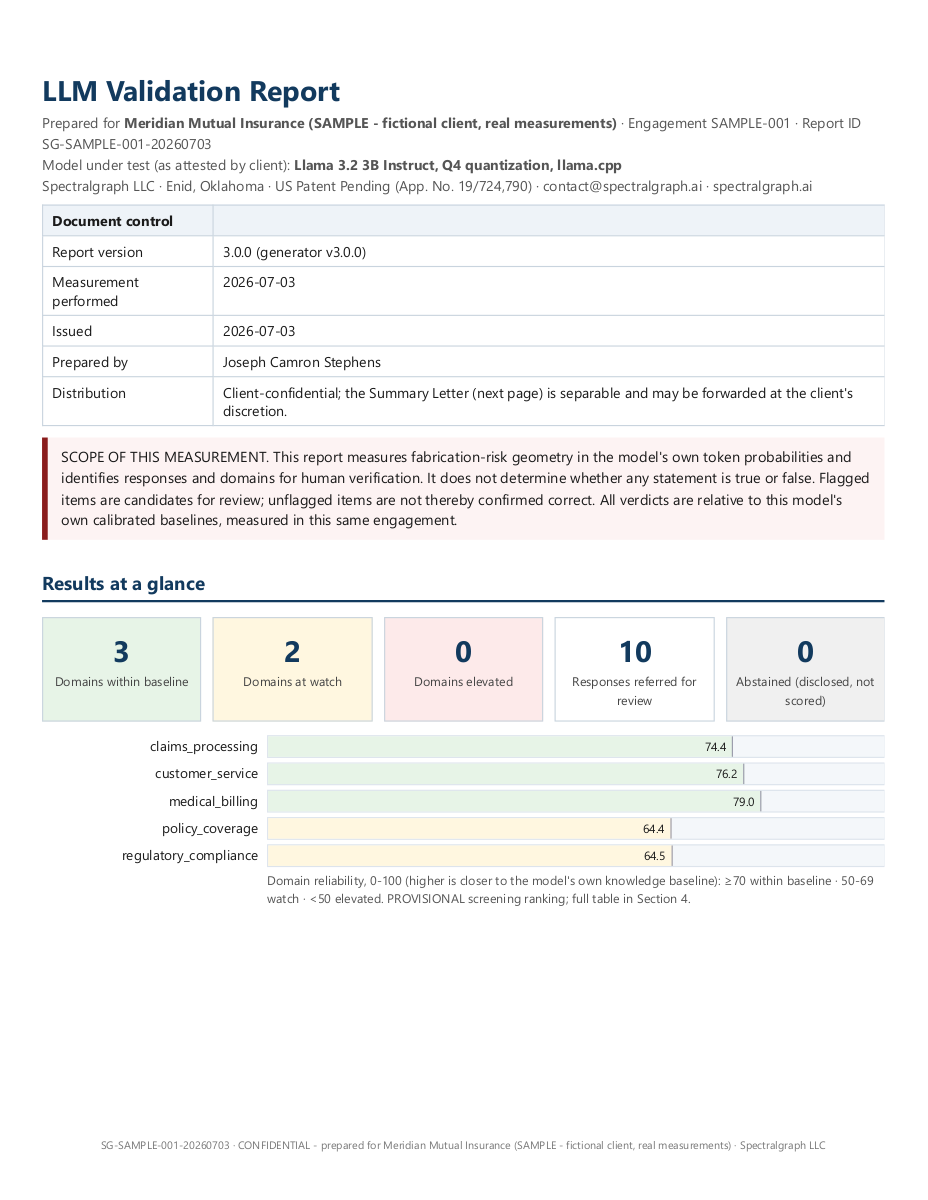
The sample report is real measurement on a fictional client. Read it first.
- Per-domain reliability, mapped to the question types you actually run
- The specific flagged answers, so your team can check each one
- Findings file included, so every number in the report is verifiable
Delivered by email, same day. No call required.
The organizations we measure for.
Insurers
Evidence for OID Bulletin 2024-11, on the models you run.
Banks & credit unions
A dated baseline and quarterly trend record, ready before the examiner asks.
Health systems
Validation evidence for Joint Commission RUAIH. No PHI by design.
Law firms
Confidentiality-safe measurement for self-hosted models. Client files never touched.
Sovereign & data-sovereignty organizations
The measurement runs entirely inside systems you control, for organizations where that isn't negotiable.
PROOF OF METHOD
We ran this instrument across 18 open-weight models and 15 professional and regulated domains under identical conditions, and published every score, so you can check the method yourself. More on how it compares to published interpretability research on The lab.
AI Reliability Index →
Four commitments, in writing.
Every report is signed by name and dated.
Any factual or methodological error your reviewers find is corrected and the report re-issued at no cost.
Errors and omissions coverage is bound before any client work begins.
Every technical question your examiners or reviewers raise gets a written answer, on the record.
What an engagement costs.
Every fee is fixed and published on one page, for organizations that run AI and for companies that sell it. The fee is the same whatever the measurement finds.
No work begins without a signed engagement letter. Everything you share is held confidential under a written agreement first.
The questions a careful buyer should ask.
What access does this require?
Is this an audit or a certification?
Who does the work?
What does the measurement not do?
More questions answered on the FAQ: hospital BAAs, confidential supervisory information, the first-engagement guarantee in full, and what the lab stands behind.
The next step is one email.
One email gets you the complete sample report. Put it in front of your risk committee and judge the deliverable itself.
Read the sample report